

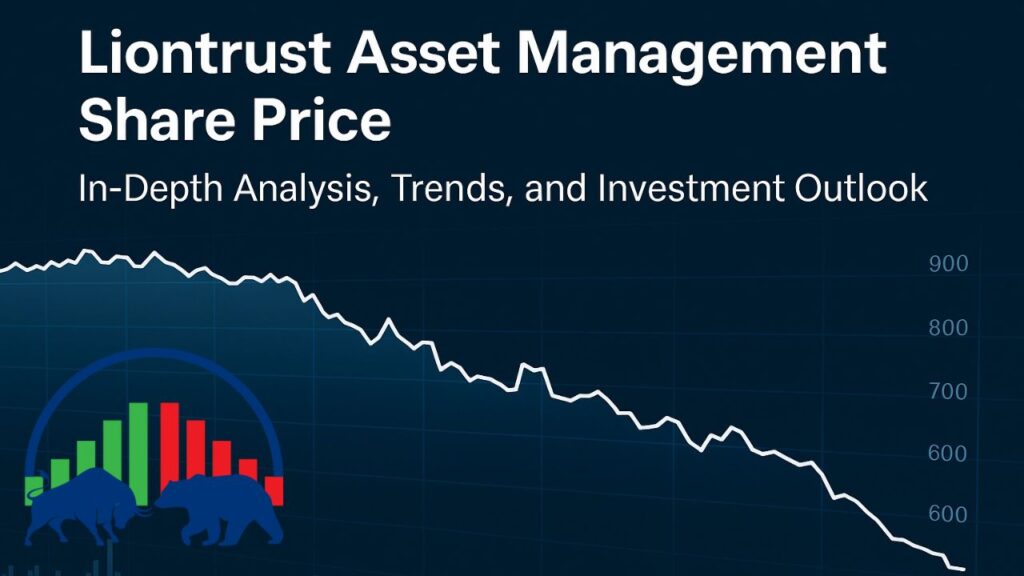
The Liontrust Asset Management (LSE: LIO) share price has seen a Liontrust Share Price Falling sharp decline in 2025. The company, once known for its active-management success, is now struggling with asset outflows, weak profitability and sector headwinds.
This decline isn’t due to any single issue – it’s a combination of declining assets under management, investor sentiment, and dividend uncertainty.
Key Financial Liontrust Snapshot
| Metric | Latest Figure (Q3 2025) | Change YoY | Source |
|---|---|---|---|
| Assets Under Management (AuMA) | £22.0 billion | ▼ 2.7% | Proactive Investors |
| Net Outflows | £1.2 billion | Worse than last year | TipRanks |
| Dividend Outlook | Cut by ~30% | Negative | Deutsche Bank |
| Share Price | Near 7-year low | ▼ over 40% YTD | Investing.com |
1. Continuous Outflows & Shrinking Assets
Liontrust Share Price core challenge is the steady stream of client withdrawals. When investors pull money out of funds, the company earns less in management fees.
| Period | Net Outflows | Commentary |
|---|---|---|
| Q1 2025 | £1.1 billion | Weak fund demand |
| Q3 2025 | £1.2 billion | No improvement in trend |
| 2024 FY | £3.4 billion | Sustained erosion of AuMA |
Reasons for outflows:

- Underperformance of flagship UK equity funds.
- Ongoing shift from active to passive strategies.
- Investor caution amid weak UK markets.
2. Margin & Profitability Pressure
With declining AuMA, Liontrust’s profit margins are squeezed. The company has taken cost-saving measures, including job cuts and expense reductions.
| Indicator | 2025 Status | Notes |
|---|---|---|
| Profit before tax | ▼ 28% | Year-on-year decline |
| Cost-cutting plan | Active | Targeting £10m+ savings |
| Dividend safety | At risk | Analysts warn of cuts |
City A.M. and RBC analysts have both flagged that the dividend yield may not be sustainable if profits continue to fall.
3. Structural Shift: Passive vs. Active Investing
The active-management industry is losing ground to cheaper, index-tracking (passive) funds. This hurts Liontrust more than global peers.
| Segment | Trend | Impact on Liontrust |
|---|---|---|
| Passive funds (ETFs, trackers) | Rapid inflows | Competitors gaining market share |
| Active equity funds | Persistent outflows | Liontrust’s main business |
| ESG/ethical funds | Moderate recovery | Still not offsetting losses |
More than two-thirds of Liontrust’s funds underperformed their benchmarks over the past year — making it harder to retain investors.

4. UK Market Weakness
Liontrust has heavy exposure to UK equities, a market that’s lagged behind the U.S. and global peers.
| Factor | Impact |
|---|---|
| UK political & budget uncertainty | Deters investor confidence |
| Low UK stock valuations | Weakens fund performance |
| Retail investor sentiment | Still cautious post-Brexit & inflation |
While some analysts believe UK equities are undervalued, sentiment remains weak, keeping flows negative for UK-focused fund managers like Liontrust.
5. Dividend & Capital-Allocation Concerns
Dividends are crucial for investor confidence, especially in asset-management firms. A cut is often seen as a sign of stress.
| Dividend Year | Forecast | Analyst View |
|---|---|---|
| FY2024 | 29p | Maintained |
| FY2025 | 24p | Likely cut |
| FY2026 | 20p | Deutsche Bank downgrade |
In October 2025, Deutsche Bank revised its price target downward after Liontrust’s dividend policy was changed. Investors interpreted this as a sign of weaker future cash flow.

6. Cost-Cutting & Recovery Plans
Liontrust has introduced restructuring and cost-saving measures to restore profitability.
These include:
- Staff reductions across divisions.
- Operational streamlining and digital initiatives.
- A limited share buyback to support the share price.
While these efforts are positive, analysts warn that cost savings alone can’t reverse outflows — Liontrust must regain investor trust and fund performance.
7. What Could Turn Things Around?
| Potential Catalyst | Description | Likelihood |
|---|---|---|
| Stabilised fund performance | Better returns vs. peers | Moderate |
| Recovery in UK equities | Could improve flows | Medium |
| Rebound in active-fund sentiment | Investors rotate from passive | Low–Medium |
| Global diversification | Expanding beyond UK focus | Possible in 2026 |
CEO John Ions has indicated that international expansion and diversification are priorities for 2026, but results may take time to materialise.
8. Analyst Outlook
| Analyst | Rating | Price Target | Comment |
|---|---|---|---|
| RBC | Underperform | £3.90 | “Slower recovery in flows” |
| Deutsche Bank | Hold | £4.10 | “Dividend risk priced in” |
| Peel Hunt | Neutral | £4.30 | “Long-term value if outflows stabilise” |
Overall, analysts agree that Liontrust remains in recovery mode — undervalued on some metrics, but still risky without clear turnaround signs.

Read also:-
Final Thoughts:-
Liontrust’s share price is falling due to a mix of fund outflows, profitability challenges, structural headwinds, and dividend uncertainty.
The company’s success depends on its ability to stabilize AuMA, improve fund performance, and rebuild investor confidence.
For investors, this means short-term caution, but the potential for long-term opportunity—if Liontrust successfully adapts to the changing investment landscape.
